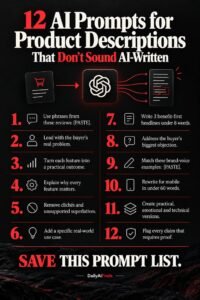
Writing product descriptions may seem simple, but creating descriptions that actually help people make buying decisions takes time and skill.
A good product description needs to explain what the product is, highlight its benefits, answer common questions, match the brand’s voice, and give shoppers a reason to take the next step.
For businesses with dozens, hundreds, or even thousands of products, writing unique descriptions for everything can become a major task.
This is where artificial intelligence (AI) can help.
AI writing tools can help ecommerce businesses, online sellers, marketers, and entrepreneurs create product description drafts quickly. They can also help improve existing descriptions, adjust tone, organize product information, generate variations, and make descriptions easier to read.
However, AI should not be used as a shortcut to publish generic descriptions. The best results come from combining AI’s speed with accurate product information and human editing.
In this guide, you’ll learn how to use AI for product descriptions, including practical prompts, examples, optimization tips, and common mistakes to avoid.
Why Use AI for Product Descriptions?
Writing product descriptions manually can take a surprising amount of time.
Imagine you have 100 products and want to create a unique description for each one. Even if each description takes only 10 minutes, that’s more than 16 hours of writing.
AI can reduce the amount of time spent creating first drafts.
It can help you:
- Create product description drafts
- Highlight product benefits
- Rewrite boring descriptions
- Adjust your brand voice
- Generate multiple versions
- Improve readability
- Create short and long descriptions
- Organize product features
- Generate bullet points
- Suggest calls to action
- Adapt descriptions for different audiences
The important thing is to give AI accurate information and review every description before publishing it.
1. Give AI Detailed Product Information
The quality of an AI-generated description depends heavily on the information you provide.
Don’t simply tell an AI tool:
“Write a product description for a backpack.”
That leaves too much room for assumptions.
Instead, provide details such as:
- Product name
- Product type
- Materials
- Size
- Color
- Features
- Intended users
- Main benefits
- Use cases
- Warranty information
- Care instructions
- Important limitations
- Price, if relevant
- Brand voice
For example:
“Write a product description for a lightweight waterproof laptop backpack made from recycled polyester. It has a padded 15-inch laptop compartment, two side pockets, adjustable shoulder straps, and a front organizer pocket. It is designed for students and professionals who commute daily.”
The second prompt gives AI enough information to create a much more useful draft.
2. Focus on Benefits, Not Just Features
One of the most important rules of product descriptions is understanding the difference between features and benefits.
A feature tells the customer what the product has.
A benefit explains why that feature matters.
For example:
Feature: Padded laptop compartment.
Benefit: Helps protect your laptop from everyday bumps and scratches while you’re commuting.
Both are useful, but the benefit connects the feature to the customer’s needs.
Ask AI:
“Turn these product features into customer-focused benefits. Do not invent information that isn’t provided.”
This can make descriptions more persuasive without making unrealistic claims.
3. Use AI to Identify the Target Customer
Different customers care about different things.
A professional may care about durability and convenience, while a student may care more about price, style, and portability.
AI can help you adapt descriptions to different audiences.
Try:
“Identify the most likely target customers for this product and explain which features and benefits would matter most to each group.”
You can then create descriptions that speak directly to your intended audience.
4. Create a Consistent Brand Voice
If your store has hundreds of products, you don’t want every description to sound completely different.
AI can help you maintain a consistent tone.
Your brand voice might be:
- Friendly
- Professional
- Minimalist
- Playful
- Premium
- Casual
- Technical
- Educational
For example:
“Write this product description in a friendly, confident, and conversational tone. Avoid exaggerated claims and unnecessary technical language.”
You can also give AI examples of descriptions you’ve already approved and ask it to follow the same style.
5. Create Short and Long Product Descriptions
Different parts of an ecommerce website may require different lengths.
You might need:
- A short product summary
- A full product description
- Bullet-point features
- A product page introduction
- A marketplace listing
- Social media copy
AI can create multiple versions from the same product information.
For example:
“Create a 50-word short description, a 150-word product description, and five feature-benefit bullet points using only the information provided.”
This saves you from rewriting the same product information repeatedly.
6. Use AI to Improve Existing Product Descriptions
You don’t always need to start from scratch.
If you already have descriptions that are boring, outdated, or difficult to understand, AI can help improve them.
Give AI the original description and ask:
“Rewrite this product description to make it clearer, more engaging, and customer-focused. Keep all factual information accurate and do not add unsupported claims.”
This is particularly useful if your online store has old product descriptions that haven’t been updated in years.
7. Turn Technical Specifications Into Customer-Friendly Copy
Some products have complicated specifications.
For example:
- Electronics
- Software
- Tools
- Appliances
- Cameras
- Fitness equipment
A technical specification may be useful to an expert but confusing to an ordinary shopper.
AI can help translate technical information into simpler language.
Try:
“Explain these product specifications in simple language for a beginner. Keep the technical information accurate and explain why each specification matters.”
This can make your product pages easier to understand.
8. Generate Product Description Bullet Points
Many shoppers scan product pages rather than reading every paragraph.
Bullet points make important information easier to find.
For example:
- Lightweight design for everyday carrying
- Padded compartment for compatible laptops
- Adjustable shoulder straps
- Multiple storage pockets
- Water-resistant exterior
AI can turn a long description into concise bullet points.
Prompt:
“Turn this product information into five concise bullet points. Focus on the most useful features and customer benefits.”
Make sure every bullet is factually supported by your actual product.
9. Create Different Descriptions for Different Platforms
You may sell the same product through multiple channels.
For example:
- Your own website
- Online marketplaces
- Social media shops
- Catalogs
- Email campaigns
Each platform may have different formatting or length requirements.
AI can help adapt the same product information.
For example:
“Rewrite this product description for a marketplace listing. Keep it concise, clear, and focused on the product’s most important features.”
You can also create a social media version:
“Turn this product description into a short social media caption that highlights the main customer benefit.”
The important thing is to keep the underlying product information consistent.
10. Use AI to Improve Product Titles
The product title is another important part of an online listing.
A vague title can make it difficult for customers to understand what they’re looking at.
AI can help generate clearer titles based on the actual product information.
For example, instead of:
Classic Backpack
you might use:
Water-Resistant Laptop Backpack With Padded 15-Inch Compartment
The exact format depends on the product and platform.
Ask AI:
“Create 10 clear product title options using the provided product information. Keep them descriptive and avoid adding features that aren’t confirmed.”
Don’t sacrifice clarity simply to make a title sound clever.
11. Use AI for Ecommerce SEO
Product descriptions can also support your search visibility.
AI can help identify relevant terms and organize information around what customers may search for.
For example, a product page for running shoes might naturally discuss:
- Running shoes
- Lightweight running shoes
- Breathable running shoes
- Running shoes for beginners
- Everyday training shoes
But avoid stuffing keywords into descriptions unnaturally.
You can ask:
“Suggest relevant search terms and related phrases for this product based on the information provided. Explain where they could naturally fit into the product page.”
Your primary goal should still be helping shoppers understand the product.
12. Create FAQ Sections for Products
Customers often have questions before buying.
AI can help identify likely questions based on the product information.
For example:
- What size is it?
- What materials is it made from?
- Is it waterproof?
- How should it be cleaned?
- What devices are compatible?
- Does it come with a warranty?
Try:
“Based only on the information provided, generate 10 frequently asked questions a customer might have about this product. Do not invent answers.”
You can then answer the relevant questions using verified information.
13. Make Product Descriptions More Persuasive
A good product description doesn’t simply list information.
It helps customers understand why the product may be useful.
AI can help you improve the flow from:
Feature → Benefit → Use case
For example:
“The insulated interior helps maintain temperature, making the lunch bag useful for keeping meals cool during a long workday.”
The description connects a feature to a practical situation.
Ask AI:
“Rewrite this description using a feature-benefit structure. Keep all claims factual and avoid exaggerated promises.”
14. Use AI to Create Product Description Variations
Sometimes you want to test different messaging.
AI can quickly generate variations based on different customer priorities.
For example:
Convenience-focused version
Emphasizes ease of use.
Durability-focused version
Emphasizes materials and construction.
Budget-focused version
Emphasizes practical value.
Lifestyle-focused version
Connects the product to everyday situations.
Prompt:
“Create three versions of this product description: one focused on convenience, one on durability, and one on everyday lifestyle use. Keep all factual details unchanged.”
This can help you discover which angle best fits your audience.
15. Use AI to Create Product Descriptions at Scale
If your store has a large catalog, AI can help establish a repeatable process.
For example:
Step 1: Collect Product Information
Create a spreadsheet containing accurate product details.
Step 2: Create a Standard Prompt
Use the same basic instructions for every product.
Step 3: Generate Drafts
Use AI to create descriptions based on each product’s information.
Step 4: Review the Drafts
Check every description for accuracy.
Step 5: Add Brand-Specific Details
Make sure the copy matches your company’s voice.
Step 6: Publish
Upload the approved descriptions to your ecommerce platform.
This approach can save significant time while maintaining consistency.
16. Never Let AI Invent Product Features
This is one of the most important rules when using AI for ecommerce.
AI may sometimes fill gaps in information by making assumptions.
For example, if you say a phone case is “protective,” AI might write that it protects against specific types of impact even if you never provided evidence for that claim.
That’s dangerous.
Never allow AI to invent:
- Materials
- Measurements
- Compatibility
- Certifications
- Warranty terms
- Performance claims
- Safety features
- Ingredients
- Guarantees
- Customer reviews
Use a prompt like:
“Use only the information provided. If information is missing, do not guess. Mark it as missing instead.”
This can reduce the risk of inaccurate descriptions.
17. Use AI to Improve Product Descriptions for Mobile Readers
Many shoppers browse online stores from mobile devices.
Long blocks of text can be difficult to read on smaller screens.
AI can help make descriptions easier to scan.
Ask:
“Rewrite this product description for mobile shoppers. Use short paragraphs, concise sentences, and bullet points while keeping the important information.”
This can improve the overall shopping experience.
18. Add Your Own Human Touch
AI can create a useful draft, but your product descriptions shouldn’t feel generic.
Add information that only your business can provide.
For example:
- Why you chose the product
- How customers commonly use it
- Your team’s recommendations
- Real customer questions
- Practical tips
- Care suggestions
- Helpful comparisons
If you’ve personally used the product, your experience can make the description much more valuable.
A Simple AI Workflow for Product Descriptions
Here’s a practical process you can use for your online store.
Step 1: Gather Accurate Information
Collect all confirmed product specifications and details.
Step 2: Define Your Customer
Identify who the product is designed for.
Step 3: Choose Your Brand Voice
Decide how you want the description to sound.
Step 4: Give AI the Product Information
Provide detailed information and clear instructions.
Step 5: Generate the Draft
Ask AI to create the description.
Step 6: Generate Supporting Copy
Create bullet points, short summaries, FAQs, or title options.
Step 7: Check Accuracy
Compare every claim against your actual product information.
Step 8: Add Human Details
Include your own experience, useful context, or brand personality.
Step 9: Optimize for Readability
Make the description easy to scan, especially on mobile devices.
Step 10: Publish and Review
Monitor customer questions and feedback, then improve the description when necessary.
Useful AI Prompts for Product Descriptions
Here are some prompts you can save and reuse.
Basic product description:
“Write a clear, customer-focused product description using only the information provided below. Do not invent missing details.”
Benefits:
“Turn these product features into clear customer benefits without making unsupported claims.”
Bullet points:
“Create five concise feature-benefit bullet points from this product information.”
SEO:
“Suggest relevant search terms for this product and show how they can be used naturally in the description without keyword stuffing.”
Editing:
“Improve this product description for clarity, readability, and persuasion while keeping all factual information unchanged.”
FAQ:
“Create 10 customer questions based only on the product information provided. Do not invent answers.”
Brand voice:
“Rewrite this product description in a friendly, confident, conversational brand voice while preserving all product facts.”
Common Mistakes When Using AI for Product Descriptions
Publishing AI Text Without Checking It
Always review the final copy.
Inventing Product Claims
Never allow AI to make unsupported promises.
Making Every Product Sound the Same
Use product-specific details to create unique descriptions.
Focusing Only on Features
Explain why the features matter to the customer.
Overusing Keywords
SEO should never make the description awkward or unnatural.
Making Descriptions Too Long
Give customers the information they need without unnecessary filler.
Ignoring Your Brand Voice
Your product pages should sound like they belong to your business.
Final Thoughts
Learning how to use AI for product descriptions can save ecommerce businesses a significant amount of time.
AI can help you create drafts, improve existing descriptions, highlight benefits, generate bullet points, create FAQs, develop product titles, and adapt copy for different platforms.
But AI-generated product copy is only useful when the underlying information is accurate.
Always provide verified product details, tell AI not to guess, review every claim, and add your own brand personality before publishing.
The best approach is simple: let AI handle the repetitive writing work while you handle accuracy, strategy, and the human side of selling.
When you use AI thoughtfully, you can create product descriptions faster while making your online store easier for customers to understand and navigate.