Creating content consistently is one thing. Creating content with a clear purpose is another.
Many businesses, bloggers, creators, and marketers publish content regularly without having a real strategy behind it. They write a blog post when they have an idea, post on social media when they remember, or create videos based on whatever seems interesting that day.
The result can be a lot of content without a clear direction.
A content strategy helps solve this problem.
It gives you a framework for deciding what content to create, who you’re creating it for, where you’ll publish it, and what you want the content to achieve.
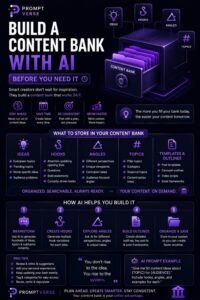
Artificial intelligence (AI) can make this process much easier. AI tools can help you research audiences, brainstorm topics, organize content pillars, identify gaps, create content calendars, repurpose existing content, and improve your workflow.
In this guide, you’ll learn how to build a content strategy with AI, even if you’re starting from scratch.
What Is a Content Strategy?
A content strategy is a plan for creating, publishing, and managing content to achieve a specific goal.
Your goal might be to:
- Increase website traffic
- Build brand awareness
- Generate leads
- Grow an email list
- Increase sales
- Educate an audience
- Build authority
- Grow a social media following
- Promote products or services
A strategy connects your content to these goals.
Instead of asking:
“What should I post today?”
you start asking:
“What content will help me reach my audience and achieve my business goals?”
AI can help you answer that question faster.
Why Use AI to Build a Content Strategy?
Building a content strategy manually can involve a lot of research and planning.
AI can help speed up many of these tasks.
You can use AI to:
- Research audience questions
- Brainstorm content topics
- Create content pillars
- Organize topic clusters
- Identify content gaps
- Generate content formats
- Build editorial calendars
- Repurpose old content
- Develop content briefs
- Suggest distribution channels
- Analyze existing content
- Improve content workflows
AI doesn’t replace strategic thinking.
Instead, it helps you organize information and explore possibilities more quickly.
1. Define Your Content Goals
The first step is deciding what you want your content to accomplish.
Without a goal, it’s difficult to know whether your strategy is working.
For example, your goal could be:
“Increase organic website traffic over the next six months.”
Or:
“Generate more qualified leads for my freelance design business.”
Or:
“Build an email audience around personal finance education.”
Your goals should influence the type of content you create.
Ask AI:
“Help me create a content strategy for a business that wants to [goal]. Suggest the types of content that could support this goal.”
AI can give you ideas, but you should choose goals based on your actual business needs.
2. Define Your Target Audience
You can’t create useful content if you don’t know who you’re talking to.
Start by identifying:
- Who your audience is
- What they want
- What problems they have
- What questions they ask
- What prevents them from reaching their goals
- What information they need
- Where they consume content
You can ask AI:
“Create a basic audience profile for a website about [topic]. Include common goals, challenges, questions, interests, and content preferences.”
Treat the result as a brainstorming tool rather than a perfect description of your audience.
Your real customers and readers should ultimately guide your decisions.
3. Identify Your Content Pillars
Content pillars are the main subjects your brand regularly discusses.
For example, a website about online business might have these pillars:
- AI tools
- Freelancing
- Digital marketing
- Productivity
- Online business
These pillars make content planning easier.
You can ask AI:
“Create five content pillars for a website about [topic]. For each pillar, give me 10 related content ideas.”
This can quickly give you a foundation for your strategy.
4. Generate Topic Ideas With AI
Once you have your content pillars, it’s time to build a topic bank.
Ask AI for different types of topics.
For example:
“Give me 30 blog topics about [content pillar]. Include beginner guides, how-to articles, mistakes, comparisons, lists, FAQs, and advanced topics.”
This creates variety instead of giving you 30 versions of the same article.
You can also ask AI to categorize the ideas by difficulty or audience level.
5. Build Topic Clusters
A topic cluster is a group of related pieces of content organized around a broader subject.
For example, suppose your main topic is:
Email Marketing
Supporting topics could include:
- How to Build an Email List
- How to Write Email Newsletters
- Email Marketing Mistakes
- How to Create Welcome Emails
- Email Subject Line Tips
- Email Marketing Automation
- How to Improve Email Engagement
You can ask AI:
“Create a topic cluster around [main topic]. Give me one comprehensive pillar topic and 15 supporting topics.”
This can help you create a more organized content library.
6. Find Content Gaps
A content gap is an important topic that hasn’t been covered adequately by your existing content.
AI can help you analyze your current content.
Give it a list of your published articles and ask:
“Analyze these existing topics and identify important related subjects that are missing. Suggest 20 content gap opportunities.”
You can then research those ideas yourself.
Content gaps can be especially useful because they help you expand your coverage without simply repeating old topics.
7. Choose the Right Content Formats
Not every idea needs to become a blog post.
Depending on the subject, you might create:
- Blog posts
- YouTube videos
- Social media posts
- Newsletters
- Podcasts
- Guides
- Checklists
- Case studies
- Tutorials
- Infographics
- Short-form videos
AI can help you decide how to present a topic.
Try:
“For each of these content topics, recommend the most appropriate format and explain why.”
For example, a detailed tutorial might work well as both a blog post and YouTube video, while a quick tip might work better as a social media post.
8. Create a Content Calendar With AI
A content calendar turns your strategy into an actionable schedule.
You can ask AI to organize your ideas by:
- Date
- Topic
- Content pillar
- Format
- Platform
- Target audience
- Goal
- Status
For example:
| Week | Topic | Format | Goal |
|---|---|---|---|
| 1 | Beginner AI Guide | Blog | Traffic |
| 1 | AI Productivity Tips | Video | Engagement |
| 2 | AI Tools for Small Businesses | Blog | Leads |
| 2 | AI Mistakes | Social Post | Awareness |
A calendar helps prevent random publishing.
9. Balance Different Types of Content
A strong strategy shouldn’t consist entirely of promotional posts.
You can divide your content into different categories.
Educational Content
Teach your audience something useful.
Problem-Solving Content
Help people overcome specific challenges.
Inspirational Content
Share stories, ideas, or examples that motivate your audience.
Engagement Content
Ask questions or encourage discussion.
Promotional Content
Introduce products, services, or offers.
AI can help you create a balanced mix.
Ask:
“Create a monthly content mix for my business using educational, problem-solving, engagement, and promotional content.”
10. Use AI to Create Content for Different Stages of the Customer Journey
Not everyone who sees your content is ready to buy.
Some people are discovering your brand for the first time.
Others are comparing options.
Some are already customers.
You can create content for different stages.
Awareness
Introduce the problem and educate the audience.
Consideration
Help people compare solutions and understand their options.
Decision
Explain your product, service, or solution.
Retention
Help existing customers get more value.
AI can help map topics to each stage.
Prompt:
“Create content ideas for each stage of the customer journey for a business selling [product/service].”
This makes your strategy more intentional.
11. Create Content Briefs With AI
Before writing an article, create a content brief.
A brief can include:
- Target audience
- Search intent
- Main topic
- Key questions
- Suggested headings
- Examples
- Internal links
- Call to action
- Desired outcome
Ask AI:
“Create a detailed content brief for a blog post about [topic]. Include the target audience, search intent, key questions, suggested structure, examples, and CTA.”
This can make writing much easier.
12. Use AI to Repurpose Content
One of the best ways to make your content strategy more efficient is to get more value from existing content.
A single article can become:
- A YouTube script
- Several social media posts
- An email newsletter
- A short video
- A checklist
- A carousel
- A podcast discussion
For example:
“Repurpose this blog post into five social media posts, three short-form video ideas, one newsletter, and one YouTube video outline.”
This allows you to create a content ecosystem instead of isolated pieces.
13. Create an Evergreen Content Strategy
Evergreen content remains useful for a long time.
Examples include:
- How-to guides
- Beginner tutorials
- Definitions
- Checklists
- Resource guides
- Frequently asked questions
AI can help identify evergreen opportunities.
Ask:
“Give me 30 evergreen content ideas about [topic] that could remain useful for years.”
You can then combine evergreen content with timely and seasonal topics.
14. Add Seasonal Content
Some topics are more relevant at particular times of the year.
Examples include:
- Holiday content
- Back-to-school topics
- End-of-year guides
- New-year planning
- Seasonal shopping
- Industry events
AI can help you brainstorm seasonal opportunities.
Prompt:
“Create a 12-month seasonal content plan for a business in [industry]. Include important seasonal themes and content opportunities.”
Always verify dates and events before publishing.
15. Use AI to Analyze Your Existing Content
Your old content can provide useful information about what is working.
AI can help you organize content based on:
- Traffic
- Engagement
- Conversions
- Topic
- Format
- Publication date
You can ask:
“Analyze this content performance data and identify which topics and formats appear to perform best. Suggest how I could use these insights to improve my content strategy.”
AI can identify patterns, but your conclusions should be based on actual data.
16. Build an Internal Linking Strategy
If you run a website, related articles should connect to each other.
For example, a blog post about:
How to Start Email Marketing
could link to:
- How to Build an Email List
- How to Write Email Newsletters
- Email Marketing Mistakes
- How AI Can Help With Email Marketing
AI can help identify possible connections.
Ask:
“Based on these article titles, suggest natural internal linking opportunities between related topics.”
Always make sure the links are genuinely useful to readers.
17. Create a Content Production Workflow
A strategy works best when you have a repeatable process.
For example:
Monday: Research topics
Tuesday: Create outlines
Wednesday: Write
Thursday: Edit and optimize
Friday: Publish and promote
AI can support several stages.
You might use it for:
- Brainstorming
- Outlining
- Draft editing
- Repurposing
- Social copy
- Content summaries
The exact workflow depends on your team and publishing schedule.
18. Create Content Faster Without Sacrificing Quality
AI can speed up content production, but publishing more content isn’t automatically better.
A useful strategy is:
Create fewer, better pieces and distribute them more effectively.
For example, instead of creating ten rushed articles, you could create four strong articles and repurpose each one across several platforms.
This gives you more opportunities to reach your audience without constantly starting from zero.
19. Keep Your Content Human
One of the biggest risks of using AI for content strategy is creating content that feels generic.
AI can generate ideas, but your content should contain things that make your brand different.
Add:
- Personal experiences
- Original research
- Customer stories
- Expert opinions
- Real examples
- Case studies
- Unique perspectives
- Lessons learned
AI should help you build the framework.
You should provide the personality and original value.
20. Review and Update Your Strategy
Your content strategy shouldn’t remain unchanged forever.
Review it regularly.
Ask:
- Which topics are performing well?
- Which topics aren’t attracting readers?
- Which formats work best?
- What questions are customers asking?
- Which content generates leads?
- Which articles need updating?
- What new opportunities have appeared?
You can ask AI to help summarize your findings:
“Based on this performance data, suggest three areas where our content strategy could improve.”
Then use your own judgment to decide what to change.
A Simple AI Content Strategy Workflow
Here’s a straightforward process you can follow.
Step 1: Define Your Goal
Decide what you want your content to achieve.
Step 2: Understand Your Audience
Identify their problems, questions, interests, and goals.
Step 3: Choose Content Pillars
Select the major subjects your brand will consistently cover.
Step 4: Generate Topic Ideas
Use AI to create a large topic bank.
Step 5: Organize Topic Clusters
Group related topics together.
Step 6: Choose Content Formats
Decide whether each topic should become a blog post, video, social post, newsletter, or another format.
Step 7: Build a Calendar
Schedule the content based on your priorities.
Step 8: Create the Content
Use AI to assist with research organization, outlines, drafts, and editing.
Step 9: Repurpose
Turn strong pieces into additional content.
Step 10: Measure Results
Review performance and improve your strategy over time.
Useful AI Prompts for Content Strategy
Here are several prompts you can save:
Content pillars:
“Create five content pillars for a brand about [topic]. Give me 15 topic ideas under each pillar.”
Topic clusters:
“Build a topic cluster around [main topic], including one pillar article and 15 supporting articles.”
Audience research:
“List the biggest questions, problems, goals, and concerns of people interested in [topic].”
Content calendar:
“Create a four-week content calendar for [business]. Include blog posts, social media content, videos, and promotional content.”
Content gaps:
“Analyze these existing topics and suggest important related subjects we haven’t covered.”
Repurposing:
“Turn this article into a YouTube outline, five social media posts, three short video ideas, and one email newsletter.”
Strategy review:
“Review this content strategy and identify gaps, opportunities, repetition, and areas for improvement.”
Common Mistakes When Building a Content Strategy With AI
Publishing Without a Goal
More content doesn’t automatically mean better results.
Relying Entirely on AI
AI can suggest ideas, but you need human judgment and audience knowledge.
Creating Too Much Content
Don’t sacrifice quality just to publish more often.
Ignoring Your Audience
Your strategy should solve real problems.
Chasing Every Trend
Not every trend is relevant to your brand.
Forgetting Existing Content
Your old content can often be updated and repurposed.
Not Measuring Results
You need performance data to know what’s working.
Making Content Too Generic
Add original insights, examples, stories, and expertise.
Final Thoughts
Learning how to build a content strategy with AI can make content marketing much more organized and manageable.
AI can help you understand audience questions, generate topic ideas, build content pillars, create topic clusters, identify gaps, organize calendars, create briefs, repurpose content, and analyze performance.
But a successful content strategy is about more than producing a large volume of content.
You need a clear goal, a defined audience, useful topics, consistent publishing, and a way to measure results.
Use AI to reduce the repetitive work and speed up the planning process, but keep your human perspective at the center.
A simple approach is:
Set your goal → understand your audience → choose content pillars → generate ideas → organize topics → create a calendar → publish useful content → repurpose it → measure results → improve your strategy.
When you combine AI with a clear strategy and genuine human insight, you can build a content system that is more consistent, efficient, and valuable to your audience.