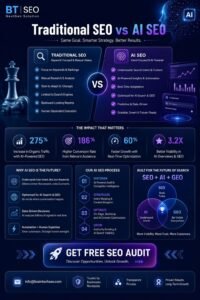
For years, search engines have been the main way people find information online. If you wanted to learn something, compare products, solve a problem, or find a website, you would usually type a few words into a search engine and browse through the results.
Today, that process is changing.
Artificial intelligence has introduced a new way to search for information. Instead of entering a short query and choosing from a list of links, people can ask AI tools questions in natural language and receive a conversational answer.
This shift is changing how people discover information, how businesses create content, and how websites compete for visibility online.
But does AI search replace traditional search engines?
Not necessarily.
Traditional search and AI-powered search work differently, and both have advantages. Understanding the difference can help students, professionals, businesses, bloggers, and website owners adapt to the changing digital landscape.
What Is Traditional Search?
Traditional search is the familiar process of entering a query into a search engine and receiving a list of results.
For example, someone might search:
“How to start a vegetable garden”
The search engine may return:
- Blog articles
- Videos
- Images
- News results
- Product pages
- Forums
- Websites
- Maps or local results
The user then chooses which result to open.
Traditional search is primarily built around helping users discover and navigate online information.
What Is AI Search?
AI search uses artificial intelligence to understand questions and generate or summarize answers.
Instead of searching for several separate pages, a user can ask a more conversational question.
For example:
“I’m a beginner with a small backyard. What vegetables are easiest to grow, and when should I plant them?”
An AI-powered search experience may provide a summarized response, explain different options, and potentially suggest follow-up questions.
This makes searching feel more like having a conversation rather than simply entering keywords into a search box.
The Biggest Difference Between AI and Traditional Search
The biggest difference is how information is presented.
Traditional search generally gives you a collection of results to explore.
AI search often tries to give you a synthesized answer to your question.
With traditional search, you might:
- Enter a query.
- Scan the results.
- Open several websites.
- Read the information.
- Compare different sources.
- Decide what answer makes sense.
With AI search, the process may look more like:
- Ask a detailed question.
- Receive a summarized response.
- Ask a follow-up question.
- Refine the conversation.
- Investigate sources when necessary.
Neither approach is automatically better. The right option depends on what you’re trying to accomplish.
Why People Are Turning to AI Search
One reason AI search is becoming popular is convenience.
People often don’t know exactly what keywords to type into a search engine.
AI allows them to explain what they need using everyday language.
For example, instead of searching:
“best laptop student programming budget”
someone could ask:
“I need a laptop for university. I’ll mainly use it for programming and general schoolwork. My budget is limited. What specifications should I prioritize?”
The second question provides much more context.
AI can use that context to produce a more tailored response.
AI Search Can Handle Follow-Up Questions
Traditional search often requires you to create a new query whenever your question changes.
AI search can make follow-up questions more natural.
For example:
User: What are the best ways to learn Python?
AI: Here are several effective approaches…
User: Which one is best for someone with no programming experience?
AI: If you’re completely new…
User: Can you create a four-week study plan?
The conversation can continue without starting from scratch.
This conversational approach is one of the biggest differences between AI search and traditional search.
Traditional Search Is Still Extremely Useful
Despite the growth of AI, traditional search isn’t disappearing.
Search engines remain extremely useful when you want to:
- Visit a specific website
- Find a local business
- Compare many sources
- Read the original article
- Find current news
- Search for images
- Watch videos
- Shop for products
- Find official documentation
- Navigate to a website
Sometimes you don’t want a summarized answer.
You want the source itself.
For example, if you’re looking for a company’s official refund policy, you may want to visit the company’s website and read the policy directly.
AI Search Can Save Time
One major advantage of AI is that it can reduce the amount of time needed to gather basic information.
Imagine researching a topic for a school assignment.
With traditional search, you might open several articles and manually compare them.
AI can help you summarize the main concepts first.
You can then use those summaries as a starting point for deeper research.
This doesn’t mean you should rely on AI without checking sources. Instead, AI can help you understand the general landscape before you investigate important information more carefully.
AI Changes How People Ask Questions
Traditional search encouraged people to think in terms of keywords.
AI encourages people to think in terms of questions and conversations.
Instead of:
“cheap healthy dinner recipes”
you might ask:
“What are five healthy dinner ideas I can make for a family of four using inexpensive ingredients?”
The second query includes more context.
This means people may increasingly search with complete sentences rather than short keyword combinations.
What Does This Mean for SEO?
The growth of AI search is also changing the world of search engine optimization, commonly known as SEO.
For many years, SEO focused heavily on helping websites rank in traditional search results.
Important areas included:
- Keywords
- Search intent
- Page structure
- Links
- Technical SEO
- Page speed
- Content quality
- Mobile usability
These factors still matter.
However, businesses and content creators now also need to think about how their information can be discovered, understood, and referenced in AI-powered search experiences.
Keywords Still Matter, But Context Matters More
Keywords remain useful, but simply repeating a keyword throughout an article is not a good content strategy.
AI systems are increasingly capable of understanding context and relationships between concepts.
For example, an article about “beginner photography” could naturally cover:
- Camera settings
- Aperture
- Shutter speed
- ISO
- Composition
- Lighting
- Lenses
- Common mistakes
Instead of repeating “beginner photography” in every paragraph, the article provides comprehensive information around the subject.
This creates a better experience for readers and gives search systems more context.
Content Quality Becomes Even More Important
As AI-generated content becomes easier to produce, simply publishing large amounts of text is unlikely to be enough to stand out.
High-quality content should provide something useful.
That could include:
- Original research
- Personal experience
- Expert insights
- Practical examples
- Case studies
- Clear explanations
- Unique opinions
- Helpful comparisons
- Original data
AI can help you create content faster, but speed alone doesn’t guarantee value.
Websites May Need to Focus More on Authority
When people ask AI systems questions, they may not always visit multiple websites themselves.
That creates a new challenge for publishers.
A website needs to establish itself as a trustworthy source.
This means businesses and content creators should focus on:
- Accurate information
- Transparent authorship
- Reliable sources
- Original content
- Expertise
- Consistent publishing
- Strong brand identity
The goal is to become a source that both people and information systems can trust.
AI Search Doesn’t Eliminate the Need for Sources
One potential problem with AI-generated answers is that AI systems can sometimes make mistakes.
An AI response may sound confident even when some information is incomplete or incorrect.
This is why source verification remains important.
For important topics, don’t simply accept the first answer you receive.
Check:
- Who published the information?
- Is the source authoritative?
- When was it published?
- Does another reliable source confirm it?
- Can you access the original document?
This is especially important for health, financial, legal, scientific, and other high-stakes information.
AI Search and Traditional Search Can Work Together
The future doesn’t have to be a competition between AI and traditional search.
They can complement each other.
For example, you might use AI to:
- Understand a complicated topic.
- Identify important questions.
- Create a list of relevant terms.
- Find potential sources to investigate.
Then use traditional search to:
- Find original sources.
- Compare different viewpoints.
- Visit official websites.
- Verify important claims.
- Find the latest information.
This combination can make research both faster and more thorough.
How AI Is Changing Content Creation
AI search is also changing how bloggers and businesses approach content.
In the past, a website might create an article primarily because a particular keyword had high search volume.
Now, content creators need to think more broadly.
Instead of asking:
“How do I rank for this keyword?”
they can ask:
“How can I create the most useful resource for someone trying to solve this problem?”
That change can lead to better content.
A strong article should answer the main question while also addressing related questions readers are likely to have.
What Bloggers Should Do Differently
Bloggers don’t necessarily need to abandon traditional SEO.
Instead, they should expand their strategy.
Focus on:
Answering Real Questions
Create content that solves specific problems.
Providing Original Insights
Share experiences, examples, research, or opinions that aren’t easily copied.
Covering Topics Thoroughly
Answer the main question and relevant follow-up questions.
Improving Readability
Use clear headings, short paragraphs, examples, lists, and simple explanations.
Building Trust
Be transparent about sources, authorship, and important claims.
Updating Content
Review older articles and update information when it becomes outdated.
What Businesses Should Do Differently
Businesses should also think beyond traditional keyword rankings.
Create content that helps customers at different stages of the buying process.
For example:
Awareness: What problem does the customer have?
Research: What solutions are available?
Comparison: How do different options compare?
Decision: Why should the customer choose your product or service?
After purchase: How can customers use the product successfully?
This creates a larger and more useful information ecosystem around your brand.
AI Search May Change Website Traffic
One concern among publishers is that AI-generated answers could reduce the number of people who click through to websites.
If someone gets a useful answer directly from an AI system, they may not need to visit several pages.
This could change how websites measure success.
Traffic will still matter, but businesses may also need to pay attention to:
- Brand visibility
- Direct traffic
- Conversions
- Leads
- Customer relationships
- Returning visitors
- Brand mentions
- Engagement
In other words, getting a click isn’t the only goal.
Building a recognizable and trusted brand may become even more important.
What Should Students Learn?
Students can benefit from understanding both AI and traditional search.
AI can help them:
- Explain difficult concepts
- Brainstorm ideas
- Summarize information
- Create study plans
- Generate practice questions
Traditional search can help them:
- Find academic sources
- Access official information
- Compare perspectives
- Locate research papers
- Verify claims
The key skill is knowing when to use each tool.
Students should also learn how to evaluate information rather than simply accepting whatever appears first.
What Should Professionals Learn?
Professionals should become comfortable using AI for research, brainstorming, summarization, and productivity while maintaining strong information-literacy skills.
A modern professional may need to know how to:
- Ask effective AI questions
- Evaluate AI-generated answers
- Find primary sources
- Verify information
- Compare different sources
- Protect confidential information
- Recognize unreliable content
These skills are becoming increasingly valuable as the amount of AI-generated information grows.
The Future of Search
Search is likely to become more conversational, personalized, and integrated into everyday tools.
People may move fluidly between traditional search, AI assistants, websites, apps, videos, and other information sources.
Instead of thinking about AI and search as completely separate technologies, it may be more useful to think of them as different ways of accessing information.
Traditional search is excellent for discovery and navigation.
AI is excellent for conversation, synthesis, explanation, and exploration.
The best experience may combine both.
Final Thoughts
AI is changing the way people search for information, but traditional search still has an important role.
The biggest change isn’t simply that people are using AI instead of search engines. It’s that people are becoming more comfortable asking detailed questions and expecting technology to help them understand information rather than simply locate it.
For users, this means learning how to combine AI with traditional research.
For bloggers and businesses, it means focusing more heavily on useful, trustworthy, original content.
And for students and professionals, it means developing strong information-literacy skills so they can evaluate what they find.
The future of search is unlikely to be purely AI or purely traditional.
Instead, AI and traditional search will increasingly work together, giving people more ways to discover, understand, verify, and use information.