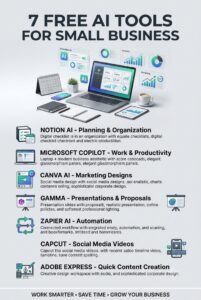
Running a small business can be exciting, but it also comes with a long list of responsibilities. Business owners often have to manage marketing, customer service, accounting, sales, content creation, scheduling, research, and administration—all while trying to grow the company.
Fortunately, artificial intelligence (AI) is making many of these tasks easier.
Today, small business owners can use AI tools to save time, reduce repetitive work, create better content, understand customers, and make more informed decisions. The technology that was once mainly available to large companies is becoming increasingly accessible to smaller businesses.
But with so many AI tools available, where should a small business owner begin?
The best approach is to choose AI tools based on the specific problems your business needs to solve.
Why Should Small Businesses Use AI?
Small businesses often operate with limited staff and budgets. An owner may be responsible for tasks that would normally be handled by several different departments in a larger company.
AI can help fill some of these gaps.
For example, a business owner can use AI to:
- Write and edit marketing content
- Respond to common customer questions
- Create social media posts
- Analyze business data
- Draft emails and documents
- Generate ideas for products and services
- Create presentations and graphics
- Organize meetings and notes
- Automate repetitive administrative tasks
- Research competitors and market trends
AI doesn’t replace the business owner’s experience or judgment. Instead, it can act as a digital assistant that helps complete routine work more efficiently.
1. ChatGPT – Best All-Purpose AI Assistant
ChatGPT is one of the most flexible AI tools available to small business owners.
It can help with many everyday business tasks, making it useful for entrepreneurs who don’t want to manage dozens of separate tools.
A business owner could use ChatGPT to brainstorm business ideas, write product descriptions, create email drafts, develop marketing campaigns, prepare customer-service responses, summarize documents, and analyze information.
For example, if you’re launching a new product, you could ask AI to help develop:
- Product descriptions
- Social media captions
- Email campaigns
- Frequently asked questions
- Blog topics
- Advertising ideas
- Customer personas
The key is to provide useful context about your business, target customers, products, and goals.
2. Canva AI – Best for Marketing and Design
Small businesses often need attractive visual content but may not have the budget to hire a professional designer for every project.
Canva can help business owners create presentations, social media graphics, flyers, posters, advertisements, menus, brochures, and other marketing materials.
Its AI-powered features can make the design process faster by helping generate layouts, content ideas, and visual concepts.
This can be especially useful for businesses that regularly publish content online.
Small businesses can use Canva for:
- Instagram and Facebook graphics
- Business presentations
- Flyers
- Promotional materials
- Product images
- Infographics
- Posters
- Social media campaigns
Good design still requires human judgment, but AI can reduce the amount of time needed to create a professional starting point.
3. Google Gemini – Useful for Everyday Business Productivity
Google Gemini can be useful for entrepreneurs who already rely heavily on Google’s ecosystem.
Business owners can use AI to brainstorm ideas, draft documents, summarize information, analyze content, and organize tasks.
For example, you could use an AI assistant to turn rough meeting notes into a structured action plan or transform a list of marketing ideas into a campaign schedule.
Businesses already using Google’s productivity tools may find AI particularly useful when it fits naturally into their existing workflow.
4. Grammarly – Best for Business Communication
Communication can have a major impact on how customers perceive a business.
Poor grammar, unclear emails, or confusing website copy can make even a good business appear less professional.
Grammarly’s AI-powered writing features can help business owners improve grammar, spelling, clarity, tone, and readability.
It can be useful for:
- Customer emails
- Website copy
- Business proposals
- Product descriptions
- Job advertisements
- Marketing messages
- Social media posts
AI-powered editing is especially useful for small businesses that don’t have a dedicated communications or copywriting team.
5. Perplexity – Useful for Business Research
Research is another area where AI can help small businesses save time.
Entrepreneurs may need to research competitors, industry trends, customer preferences, new technologies, or potential markets.
AI research tools such as Perplexity can help users explore topics and locate sources more efficiently.
For example, a business owner could research:
“What are the latest trends in online shopping among small businesses?”
The results can provide starting points for further research.
However, business owners should verify important information using reliable original sources before making significant financial or strategic decisions.
6. Notion AI – Best for Organization
Running a business involves managing a large amount of information.
Notion AI can help businesses organize notes, projects, documents, meeting information, and internal knowledge.
A small business could use it to create a central workspace containing:
- Company procedures
- Project plans
- Meeting notes
- Marketing calendars
- Employee information
- Business goals
- Product information
- Customer-service guidelines
AI can then help summarize information, organize content, and make large amounts of documentation easier to work with.
7. AI Customer Service Tools
Customer service is an important area where AI can save small businesses time.
AI-powered chatbots can answer frequently asked questions, provide basic information, and guide customers toward useful resources.
For example, an online store could use an AI assistant to answer common questions about:
- Shipping
- Returns
- Opening hours
- Product availability
- Payment options
- Order processes
The goal isn’t necessarily to remove human customer service. Instead, AI can handle simple questions while employees focus on complicated problems that require human attention.
Businesses should make it clear when customers are communicating with an automated system and provide an easy way to reach a human when necessary.
8. AI for Social Media Marketing
Maintaining an active social media presence can take a lot of time.
Business owners have to think of content ideas, write captions, create graphics, respond to comments, and maintain a consistent posting schedule.
AI can help with many of these tasks.
You can ask AI to generate:
- Content calendars
- Social media ideas
- Caption drafts
- Promotional messages
- Video concepts
- Blog topics
- Audience questions
However, completely automated social media can feel impersonal.
The best approach is to use AI to generate ideas and drafts while adding your own experiences, opinions, brand personality, and knowledge of your customers.
9. AI for Sales and Marketing
AI can also support the sales process.
Businesses can use AI to analyze customer information, identify potential leads, personalize marketing messages, and organize customer interactions.
For example, AI might help a business divide its customers into groups based on their interests or purchasing behavior.
This can make marketing campaigns more targeted.
Instead of sending exactly the same message to everyone, a business can create different messages for different customer groups.
10. AI for Financial and Administrative Tasks
Small business owners often spend considerable time on administrative work.
Depending on the software and business setup, AI can assist with tasks such as categorizing information, creating reports, analyzing expenses, and identifying unusual patterns.
However, financial information deserves special care.
AI-generated financial analysis should not automatically be treated as professional accounting or legal advice. Business owners should work with qualified professionals when making important financial, tax, or legal decisions.
How to Choose the Right AI Tools
Small business owners don’t need every AI tool available.
Using too many platforms can actually make work more complicated.
Instead, identify your biggest time-consuming tasks.
Ask yourself:
- What tasks do I repeat every week?
- Which tasks take the most time?
- Which tasks don’t require complex human judgment?
- Where do I regularly need help with writing or research?
- Which areas of my business need better organization?
Once you identify these problems, choose AI tools that directly address them.
For example:
| Business Need | Useful AI Tool Type |
|---|---|
| Writing and brainstorming | AI assistants |
| Graphic design | AI design tools |
| Research | AI search/research tools |
| Writing improvement | AI writing assistants |
| Organization | AI productivity tools |
| Customer questions | AI chatbots |
| Marketing | AI content tools |
| Coding | AI coding assistants |
| Data analysis | AI analytics tools |
How AI Can Save Small Businesses Money
One of the biggest advantages of AI is that it can help small businesses accomplish more without immediately increasing their staffing costs.
For example, if AI reduces the amount of time an owner spends writing social media content from three hours to one hour each week, that saved time can be used for sales, customer relationships, or product development.
The same principle applies to administration, research, customer service, and content creation.
However, AI should be viewed as a productivity investment rather than a guaranteed way to cut jobs or expenses.
The real value comes from helping people spend more time on work that requires creativity, judgment, and human interaction.
AI Mistakes Small Business Owners Should Avoid
AI can be powerful, but it isn’t perfect.
One of the biggest mistakes is trusting AI-generated information without checking it.
AI can make factual errors, misunderstand instructions, or produce outdated information.
Another mistake is sharing confidential information without understanding how the AI service handles data.
Business owners should be especially careful with:
- Customer information
- Passwords
- Financial records
- Private contracts
- Employee information
- Confidential business plans
Businesses should establish clear rules about which information employees are allowed to enter into AI tools.
It’s also important not to let AI completely replace human customer interaction. Customers often value empathy, understanding, and genuine communication.
Final Thoughts
AI tools can give small business owners something extremely valuable: more time.
From writing emails and creating marketing content to organizing projects and researching competitors, AI can help entrepreneurs handle everyday tasks more efficiently.
The best strategy isn’t to automate everything.
Instead, use AI for repetitive and time-consuming tasks while keeping important decisions, relationships, creativity, and strategy in human hands.
Start with one or two tools that solve a real business problem. Learn how to use them effectively, measure whether they actually save time or improve results, and then expand gradually.
For small business owners, the future of AI isn’t about replacing people. It’s about helping individuals and small teams work smarter, move faster, and compete more effectively.